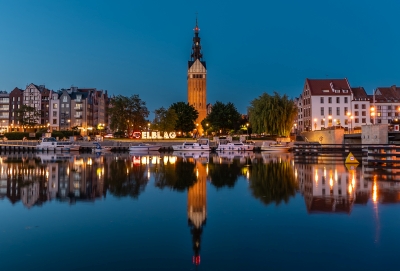
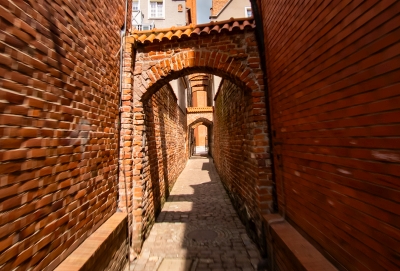
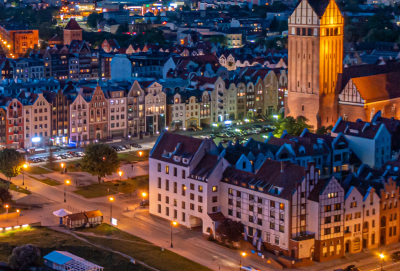
In the 14th century, Elbląg was a major port and a member of the Hanseatic League. Excavations in the Old Town bear witness to the affluence of the city's former inhabitants; archaeologists have unearthed thousands of artifacts made of amber, ceramics, glass, metal, and other materials. These finds attest to the lively trade connections maintained by the people of Elbląg with regions such as Germany, Scandinavia, England, and the Netherlands.
A significant date in the city's history was its accession to the Prussian Confederation in 1440. Following the Battle of Grunwald in 1410, the citizens of Elbląg paid homage to the Polish King Władysław Jagiełło, presenting him with the captured Teutonic castle. However, it was not until the Peace of Thorn in 1466 that Elbląg became part of the Polish state. The city was granted numerous privileges by Polish kings and developed into an important seaport. Wars that swept through the region in the 16th and 17th centuries brought plagues, looting, and forced levies.
After the First Partition of Poland in 1772, Elbląg was incorporated into the Prussian state. The city experienced a revival in the 19th century. Elbląg became part of the railway network, and the Elbląg Canal was opened for operation. Industrial plants were established, including a brewery and factories producing cigars, locomotives, and automobiles. However, the shipyard founded by Ferdinand Schichau was of particular importance to the city; vessels such as torpedo boats and submarines, as well as locomotives, were built there.
In 1945, the city returned to Poland. As a result of wartime hostilities, approximately 65 percent of Elbląg was destroyed. The Old Town suffered particularly heavy damage; historic townhouses lay in ruins, while others that had been damaged were demolished. Most of the city's original inhabitants left, and the task of rebuilding fell to resettlers. Over the years, new industrial plants and residential estates have been built. Thanks to the initiative of the city authorities, the Baltic Euroregion—one of the largest in Europe—was established in 1998, with Elbląg as a member.
A few words of introduction
The city’s origins date back to 1237, when the Teutonic Knights established a defensive castle on the banks of the Elbląg River. A trading settlement grew up around it, and in 1246, it was granted Lübeck city rights. At that time, Elbląg served as the seat of the Teutonic Order's provincial masters.