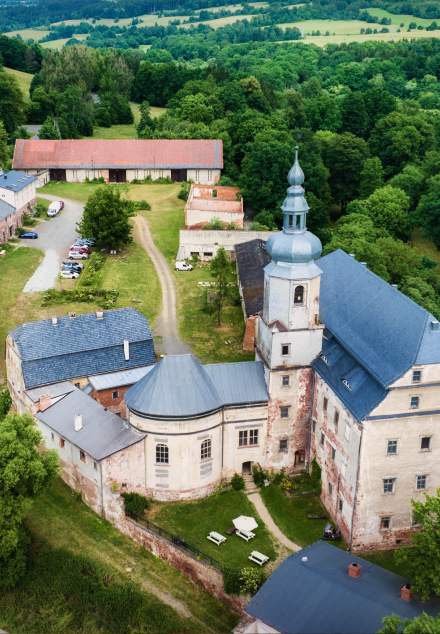
The roots of the palace complex date back to the Middle Ages, when a knight's estate stood in this area. It was a defensive manor house with a tower dominating the landscape. However, its true heyday came during the Renaissance, when a more representative residence was built in Sarny. In 1590, Fabian von Reichenbach built the second-largest manor house in the Kłodzko region here. This is when the history of the place, which was to become one of the most important residences of the local nobility, began.
The Götzen family were most closely associated with this complex—the family that gave Sarny the status of a true residence. It was they who expanded the complex, adapting it to the Baroque taste and ambitions of the owners. In the 18th century, the Chapel of St. John of Nepomuk was added to the palace, serving not only as a place of prayer but also as a clear sign of prestige.
The whole created a typical Silesian residential complex: palace, chapel, farm, outbuildings, and park. It was a "small world" of the nobility, where decisions were made about crops, work, and the fate of those working on the estates. Naturally, social life also flourished there.
In the 19th century, the historical splendor began to give way to everyday life and neglect. After World War II, things got even worse. Prince Charles came close to acquiring the complex—wait for it! Yes, we're talking about the current King of Great Britain! His foundation took an interest in the palace in 2010, but ultimately, the transaction fell through.
Today, most of the building can be toured. And it's free! It's worth it, as the castle evokes scenes from fantasy films and Gothic tales. Photographers adore it. You can also enter the chapel, a Baroque masterpiece that houses incredibly valuable polychromes with images of saints. Finally, you can grab a bite to eat in the castle's unique café. You'll find it invaluable support before climbing the mountains.

Visit Social media:
Share Social media: